
Core concepts
This page explains every moving part in plain English. If you read only one reference page, read this one.
Memory
A memory is a single piece of knowledge about your codebase, written as a short, checkable statement (a claim). Each memory has:
- a kind (decision, convention, guardrail, …),
- a claim (the statement itself),
- a scope (which files/symbols it applies to — or the whole repo),
- optional evidence (how to check it's true),
- a status and a confidence score,
- and flags like pinned.
Kinds
Kinds are just categories that help organize and surface the right knowledge:
- Decision — a choice + the rejected alternatives.
- Convention — a rule the repo follows consistently.
- Gotcha — surprising behavior that wasted time.
- Failed approach — a dead end, recorded so nobody retries it.
- Architecture — how components fit together.
- Invariant — something that must always/never hold.
- Guardrail — a behavioral rule for agents with an enforcement level:
never,ask-first, oralways. See Guardrails. - Skill — a reusable procedure, often written as numbered steps. See Skills.
- Todo context — unfinished work + how to pick it back up.
Status
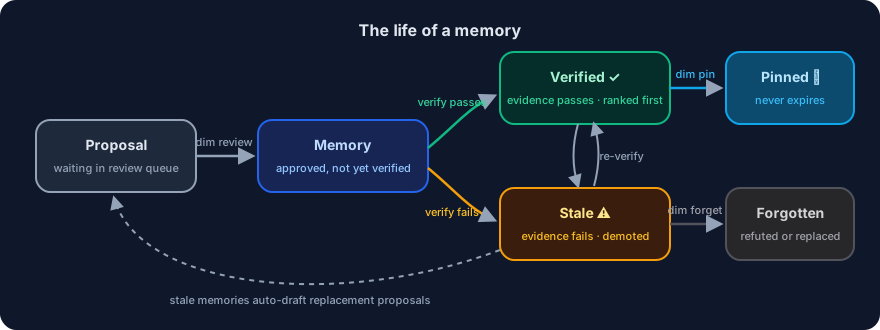
Every memory is always in exactly one of four states:
| Status | Meaning |
|---|---|
| Unverified | Stored, but its evidence hasn't confirmed it (or it has none yet). |
| Verified | Its machine-checkable evidence currently passes. Trust it. |
| Stale | Evidence that used to pass now fails — the code changed under it. Don't trust it until it recovers. |
| Refuted | Deliberately marked false (by a human or agent). Kept as negative knowledge — "we believed this until it stopped being true." |
The important rule: a failing check always makes a memory stale, no matter what else is true about it. That's what keeps memory honest.
Evidence
Evidence is how a claim proves itself. Types:
| Evidence | What the payload is | Tier |
|---|---|---|
| STATIC_CHECK | A shell command; exit code 0 means the claim holds | cheap |
| COMMIT_REF | A commit SHA that must exist/be an ancestor (optionally sha:path1,path2) | cheap |
| TEST_RESULT | A test command, run with CI=1; exit 0 = pass | deep |
| EXEC_TRACE | command :: expected-output-regex; passes if output matches | deep |
| HUMAN_ATTESTED | "A human said so" — verifies once, then decays fastest | — |
| TICKET_REF | Links the memory to a ticket (e.g. XXX-2100) | — |
"Cheap" evidence runs automatically (e.g. on every git pull). "Deep" evidence runs only when you ask (dim verify --deep), because it executes tests.
Confidence and decay
Each memory carries a confidence between 0 and 1. Two forces move it:
- Evidence — passing checks raise it; failing checks floor it.
- Time — knowledge that can't be machine-re-verified decays (loses confidence gradually). A verified memory whose confidence decays too far is quietly demoted back to unverified. Trust expires unless it's re-confirmed.
This is deliberate: a fact nobody has checked in months should be trusted less than one that passed its check this morning.
Pinned memories
Some knowledge should never expire — a foundational architectural decision, a hard rule. You can pin a memory:
- Pinned memories are exempt from time decay (they won't fade just from age).
- They are still falsifiable — if their evidence fails, they still go stale.
"Never decays" is not the same as "never wrong." See Pinned memories.
Proposals and the review gate
aiDimag never adds memory behind your back. Knowledge that's inferred — by the commit miner, by an agent at the end of a session — enters a proposal queue instead of becoming active memory. You approve, reword, or reject each one with dim review. This is the human gate, and it's the reason you can trust what's in the store. See The review queue.
The three layers (Spec · Verifier · Environment)
aiDimag is organized around a simple framework popularized by Andrej Karpathy:
- Spec — give the agent your understanding in a usable form. aiDimag injects relevant memories and a session briefing.
- Verifier — let the work be checked. aiDimag re-runs evidence, offers
memory_critique, and catches contradictions before commits withdim check. - Environment — a persistent, improving workspace. The
.aidimag/folder, generatedCLAUDE.md, guardrails, and skills.
You don't need to think about these layers to use aiDimag, but they explain why the features fit together the way they do.
Where everything lives
your-repo/
├── .aidimag/
│   ├── memory.db          # the SQLite store (gitignored by default)
│   └── config.json        # repo settings (safe to commit — no secrets)
├── CLAUDE.md              # generated context (optional)
└── .git/hooks/            # additive hooks aidimag installs
Next: How it works for the mechanics, or Getting started to set it up.